

Why OneNote Is Not Syncing: Causes, Fixes, and Admin Tips
Updated November 2026: I rewrote this post to match the current OneNote app, removed advice tied to the retired OneNote for Windows 10, added a full error code table, and added a section for admins on the SharePoint library settings that quietly break notebook sync.
When OneNote stops syncing, the first thing I want to know is where the problem is: this one device, this one notebook, or Microsoft's side. Once you know that, the fix is usually quick. Here's how I narrow it down, what the common error codes actually mean, and what admins should check when it's more than one person.
Before You Start: Don't Sign Out or Reinstall
This is the biggest mistake I see. Someone's notebook won't sync, so they sign out of Office, uninstall OneNote, or delete the notebook and reopen it. If OneNote is holding changes that never made it to OneDrive or SharePoint, all of those moves can throw them away.
Microsoft's own troubleshooting guidance says the same thing: don't sign out, sign in again, or reinstall while you're troubleshooting sync. Work through the steps below first. If you do end up needing one of those, copy anything important out of the notebook (even into a Word doc) before you do it.
First, Sync It by Hand
In the OneNote desktop app, press Shift + F9 to sync every notebook. To see what's actually stuck, right-click the notebook name and choose Notebook Sync Status, or go to File > Info > View Sync Status. That window lists each notebook and any section with an error, and it has Sync All and Sync Now buttons.
A lot of sync errors are temporary and clear on the next try. If they come back, note the error code shown in the window or in the yellow bar at the top of the section, then keep going.
While you're there, check that automatic sync is still on. Go to File > Options > Sync and make sure Sync notebooks automatically is checked. I've seen this turned off by someone trying to save battery and then forgotten for months.
Open the Same Notebook on the Web
This is the test that saves the most time. Open the notebook in OneNote for the web and look for your latest changes. The easiest way is File > Info in the desktop app, then right-click the notebook's link and copy it into a browser. You can also open it from OneDrive or the SharePoint library it lives in.
OneNote for the web saves as you type. Click the cloud icon near the top right and it tells you whether the page is saved and when it last synced.
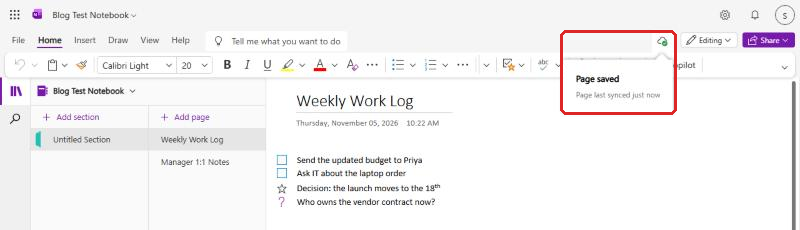
- Your changes are there, and the web works fine: the problem is on your device. Skip to the device fixes below.
- The changes you made on the web don't reach your PC: also a device problem. The service has your notes; your app isn't picking them up.
- The web version won't open or is missing changes from every device: the problem is the notebook itself, its storage, or the service. Check service health and the library settings next.
Check Service Health the Right Way
If you're an admin, go to the Microsoft 365 admin center and open Health > Service health. One thing that trips people up: OneNote doesn't have its own line in the list. OneNote notebooks are stored in OneDrive and SharePoint, so those are the services to look at, along with Microsoft 365 apps and Microsoft 365 suite for app-level issues.
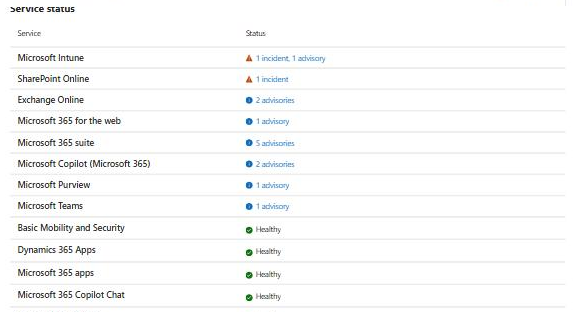
When I took this screenshot, SharePoint Online had an open incident and the Microsoft 365 suite had several advisories, one of them about the OneNote Web Clipper. That's a good example of why it's worth clicking into the advisories instead of just looking at the colors.
If you're not an admin, you won't see this page. Ask your IT team, or wait an hour and try again if colleagues are reporting the same thing.
Common OneNote Sync Error Codes
OneNote errors look cryptic, but most of them fall into a few groups: connection, sign-in, space, permissions, or a damaged section. Here are the ones I see most, with what they mean and what to try.
0xE4010641 (network disconnected)
OneNote lost its connection to wherever the notebook is stored. Wait a few minutes, check that you're online, and press Shift + F9. If it keeps happening, go to File > Info and look at the notebook's location. If it points to a server or path that no longer exists, the notebook was moved, and you'll need to open it again from its new home. Don't sign out to fix this one. If several people get it at once, it's usually a network or proxy issue, not their PCs.
0xE000002E (out of sync with the store)
This one is usually temporary. Sync by hand with Shift + F9 and give it a few minutes. It tends to clear on its own once the service catches up.
0xE000005E (ReferencedRevisionNotFound)
A section got out of step, often after edits from more than one device at the same time. Retry the flagged section in Notebook Sync Status. If the same section keeps failing, use the new section workaround further down.
0xE0000024 (authentication)
OneNote can't prove who you are to the server. Open Credential Manager in Windows, go to Windows Credentials, and remove saved entries that start with MicrosoftAccount or MicrosoftOffice for the account in question. Restart OneNote and sign in when prompted. A "server is busy" message that won't go away is often the same kind of sign-in problem.
0xE00015E0 (not enough space)
Your device is low on space or the local OneNote files are too big. The fix for this is in the space section below.
Other codes worth knowing
- 0xE0000796: the storage quota is used up. Free up space in OneDrive or the SharePoint site.
- 0xE0000025: a file in the notebook is too large. Look for big embedded files or printouts and move them out.
- 0xE0190193: 403 forbidden. You don't have permission to the notebook's location anymore. The owner or an admin needs to check sharing.
- 0xE0000784: WebDAV is disabled on the server, which mostly affects on-premises SharePoint.
- 0xE000078B: the request timed out. Usually a slow or unstable connection.
- 0xE4020040: the store is busy. Wait and sync again.
- 0xE4020045: the notebook isn't supported in its current location. This happens when someone drags a local notebook folder into OneDrive in File Explorer. OneNote notebooks need to be moved with OneNote itself (File > Share > Move Notebook), not copied as files.
- cig68 / 0xE000006C: often shows up with a prompt to refresh. Update OneNote first.
When One Section Won't Sync
Sometimes the whole notebook is fine except one section that stays stuck with an error no matter what. Rather than fight it, rebuild it:
- Create a new section in the same notebook.
- Select the pages in the broken section, right-click, and choose Move or Copy. Copy them to the new section.
- Press Shift + F9 and confirm the new section syncs without errors.
- Check the pages on the web to make sure they arrived.
- Delete the old section once you're sure everything is in the new one.
This works because the error is tied to the damaged section file, not your content. A fresh section gets a clean file.
Misplaced Sections
If OneNote can't sync a section at all, it may move it to Misplaced Sections at the bottom of the notebook list. That's your content saved locally with nowhere to go. Right-click it and choose Move to put it back into a notebook that syncs. Don't delete Misplaced Sections until you've moved what you need out of them.
Check the Notebook Recycle Bin
If pages or sections seem to have disappeared after a sync problem, look in History > Notebook Recycle Bin before you panic. Deleted pages stay there for 60 days. A corrupted section sometimes ends up there too. While you're in the History tab, Recent Edits and Find by Author are useful for working out who changed what in a shared notebook.
Merge Conflict Pages
When two people (or you on two devices) edit the same paragraph before syncing, OneNote can't pick a winner. It keeps one version and shows a yellow bar at the top of the page saying there are conflicting changes. Click it to see the other version, copy anything you need into the main page, and then delete the conflict page. Leaving lots of conflict pages around doesn't break sync, but it does make the notebook confusing for everyone.
"Content Not Yet Available"
If you open a page and see "Content not yet available," the page exists but its contents haven't arrived. This usually means another device made the change and hasn't finished syncing it up. Have that person open OneNote and sync with Shift + F9. If it's your own other device, open it and do the same. There's nothing to fix on the device showing the message.
Check Space on the Device and in OneDrive
Space problems show up in two places, and people often check only one.
Local space and OneNote backups
The desktop app keeps a local cache and backup copies, and those can grow large. Go to File > Options > Save & Backup:
- Click Optimize All Files Now to shrink the local files.
- Lower Number of backup copies to keep if you don't need many.
- If space is still tight, close OneNote and clear out the backup folder at
%localappdata%\Microsoft\OneNote\16.0\Backup. These are backups, not your live notebooks, but glance through them first in case you want to keep one.
OneDrive and SharePoint storage
A full OneDrive or SharePoint site stops syncing for everything, OneNote included. In OneDrive on the web, go to the settings gear, open OneDrive settings, then More settings > Storage Metrics. The free space is shown at the top right, and the list shows which folders are using it.
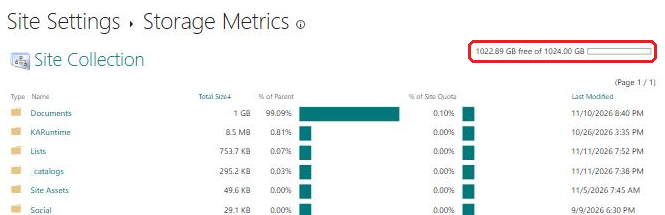
Remember that the recycle bin counts against storage too. If someone deleted a pile of large files to make room and it didn't help, empty the recycle bin as well.
Fixes on Your Own Device
- Check the account. In File > Account, make sure you're signed in with the account that owns the notebook. Using a personal account when the notebook lives in your work OneDrive is a common cause. If you need to add the right account, add it there rather than signing the other one out.
- Close and reopen the notebook. Make sure your changes are on the web first. Then right-click the notebook and choose Close This Notebook, and reopen it from OneNote for the web with Editing > Open in Desktop App. If the notebook was moved or renamed, this reconnects it to the right place.
- Update OneNote. Use the OneNote app that comes with Microsoft 365. OneNote for Windows 10 has been out of support since October 2025, so if you're still on it, this is a good time to switch. You can tell which one you have in Settings > Apps > Installed apps: the old one is listed as "OneNote for Windows 10."
- Reset the cache last. A damaged local cache can block syncing. Check that your changes are on the web first, close OneNote, and then rename the cache folder. By default it's at
%localappdata%\Microsoft\OneNote\16.0\cache, and the exact path is shown in File > Options > Save & Backup. OneNote rebuilds it when it opens. Anything that never synced and only lives in that cache can be lost, which is why this is the last step, not the first.
For Admins: When Lots of People Are Affected
- Check SharePoint Online and OneDrive in Service health first, as above.
- If many users see 0xE4010641 or time-out errors, look at proxy, firewall and SSL inspection rules for Microsoft 365 endpoints before you look at anything else.
- Confirm the affected users still have a license that includes OneDrive or SharePoint and that they have free storage space.
- Make sure your device management is deploying the current OneNote app, not the retired Windows 10 one.
- If one user's sign-in keeps failing on several apps, that's an identity problem, not a OneNote one. My post on why SharePoint keeps asking for credentials covers the usual causes.
SharePoint Library Settings That Break Notebook Sync
Shared team notebooks usually live in a SharePoint document library, and a few library settings that make sense for Word files cause real trouble for OneNote. If a whole team's notebook won't sync but their personal notebooks are fine, check these in Library settings.
- Require Check Out should be No. OneNote is built for many people editing at once. If the library forces checkout, sections get locked and sync fails. You'll find it under Versioning settings.
- Don't turn on minor versions. Microsoft specifically recommends against major and minor (draft) versioning on libraries that hold OneNote notebooks. Major versions only is fine.
- Watch out for Draft Item Security. If it's set so only certain people can see drafts, other editors can't see changes and sync breaks for them.
- Avoid required columns. If the library has a required metadata column with no default, OneNote can't fill it in when it creates new section files, so new sections fail to save. Give the column a default value or make it optional.
- Information Rights Management (IRM). Libraries protected with IRM block OneNote from uploading sections. Keep notebooks in a library without it.
Changing these settings affects every file in the library, so check with the site owner first. If a library has to keep checkout or required columns for compliance reasons, the cleanest answer is to give the notebook its own library.
Also be careful with retention cleanups on these libraries. If you're tidying a site, my post on permanently deleting files in SharePoint explains what happens to deleted items, which matters if a notebook's sections end up in the recycle bin.
Frequently Asked Questions
My notes show up on the web but not on my PC. What now?
The problem is on your PC. Close the notebook in the desktop app and reopen it from OneNote for the web. If that doesn't do it, check the account in File > Account and make sure the app is up to date.
Should I sign out of Office to fix OneNote sync?
Not as a first step. Signing out can remove changes that haven't synced yet. Work through the other steps first, and copy out anything important before you sign out.
How do I know if Microsoft is having an outage?
Admins can check Health > Service health in the Microsoft 365 admin center. Look at SharePoint Online and OneDrive, since that's where notebooks live.
Should I clear the OneNote cache?
Only after the other steps, and only after you've confirmed your recent changes are on the web. Changes that never synced can be lost.
Why does only our team notebook fail to sync?
Look at the SharePoint library it's stored in. Require Check Out, minor versioning, required columns and IRM are the usual culprits.
Final Thoughts
Most OneNote sync problems come down to the same question: does the web copy have your changes? If it does, the fix is on the device, and it's usually a sync by hand, the right account, or reopening the notebook. If it doesn't, look at storage, permissions, the library settings, and service health. The one habit worth building is resisting the urge to sign out or reinstall until you know your notes are safe on the server.
Sources: Fix issues when you can't sync OneNote (Microsoft Support), Overview of co-authoring in SharePoint Server (Microsoft Learn), How to check Microsoft 365 service health (Microsoft Learn).